

Managing multiple logistics activities, vendors, and locations can create operational complexity. Fragmented communication, inconsistent reporting, and unclear responsibilities can affect service quality, visibility, and cost control.
Third-party logistics (3PL) and fourth-party logistics (4PL) models offer businesses different ways to manage these challenges. While 3PL typically focuses on executing defined logistics activities, 4PL generally takes a broader approach to coordinating logistics providers, processes, and performance.
ZeNXL helps businesses connect selected logistics functions through agreed operating processes, partner coordination, reporting, and escalation mechanisms.
This guide explains how 3PL and 4PL models work, how an engagement can be structured, and what businesses should consider when selecting a logistics partner.
1. What Are 3PL and 4PL Logistics Services?
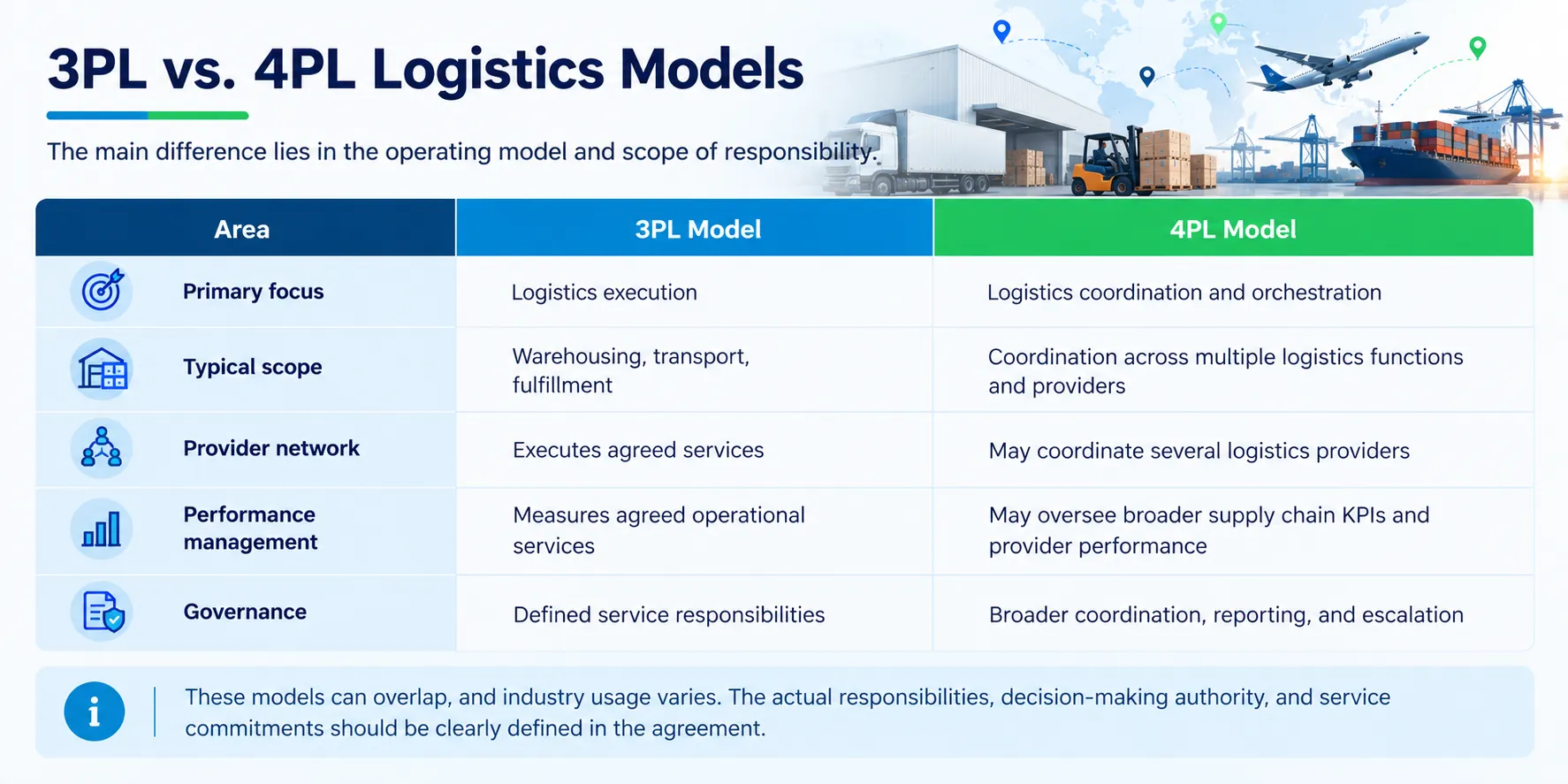
A third-party logistics provider (3PL) typically performs specific logistics activities such as warehousing, transportation, order fulfillment, and distribution.
A fourth-party logistics provider (4PL) generally coordinates a broader network of logistics services and providers, with greater emphasis on supply chain orchestration, governance, performance management, and end-to-end visibility.
The main difference lies in the operating model and scope of responsibility
6. Managing Common 3PL / 4PL Challenges
Even well-planned logistics arrangements can encounter operational issues. Defined governance and escalation processes help manage them.
Unclear responsibility: Refer to the agreed responsibility matrix, assign an accountable owner, and update process documentation where necessary.
Partner service failure: Record the operational impact, engage the responsible provider, coordinate mitigation, and escalate according to agreed thresholds.
Inconsistent data: Identify the source of the discrepancy, agree on corrections, and introduce controls to improve future submissions.
KPI or service-level miss: Validate the measurement, investigate the root cause, agree on corrective actions, and track progress through operational reviews.
Transition disruption: Follow the transition and contingency plans, communicate service impacts, and priorities continuity of critical operations.
Scope changes: Document the requested change, assess operational and commercial implications, obtain approval, and update the agreed scope.
Clear ownership and documented follow-up help prevent recurring issues from becoming persistent operational problems.
7. Frequently Asked Questions
What is the main difference between 3PL and 4PL?
A 3PL provider typically executes defined logistics activities, such as warehousing and transportation. A 4PL model generally coordinates a broader network of logistics providers and processes, with greater emphasis on governance and overall performance.
Can a business use both 3PL and 4PL services?
Yes. A business may use 3PL providers to execute specific activities while adopting a 4PL-style model to coordinate multiple providers and logistics functions.
Does a 4PL provider own warehouses and vehicles?
Not necessarily. A 4PL model often coordinates services delivered by multiple providers and does not inherently require ownership of warehouses, vehicles, or other logistics assets.
Which KPIs should businesses track?
Relevant measures may include on-time delivery, order accuracy, inventory accuracy, cost per shipment, exception resolution time, and reporting timeliness. KPIs should reflect the actual service scope and business objectives.
How is a 3PL / 4PL transition managed?
A typical transition includes operational assessment, process design, partner and data onboarding, testing, go-live readiness checks, and post-launch reviews. The approach depends on operational complexity and continuity requirements.
Can ZeNXL manage every supply chain function?
The available services depend on ZeNXL's actual capabilities, operating locations, partner arrangements, and agreed engagement scope. Requirements should be assessed and confirmed before commitments are made.
8. Why Work with ZenXL?
An integrated logistics model can help businesses reduce fragmented communication, clarify responsibilities, and connect activities across their supply chain.
ZenXL can coordinate selected logistics functions and service providers through agreed processes, reporting, and escalation mechanisms.
Our approach focuses on:
- Connected operations: Aligning selected logistics activities through defined workflows.
- Clear accountability: Establishing responsibilities, ownership, and escalation routes.
- Operational visibility: Supporting agreed reporting and performance reviews.
- Partner coordination: Connecting relevant logistics providers where included in scope.
- Continuous improvement: Reviewing performance and coordinating approved improvements.
The objective is to help businesses build a more connected and manageable logistics operating model, supported by clear governance and realistic performance expectations.
9. Looking to Connect Your Logistics Operations?
Whether you want to outsource specific logistics functions or coordinate multiple providers across your supply chain, ZeNXL can help assess your requirements and discuss a suitable operating model.
Tell us which logistics functions you want to outsource or coordinate, the locations involved, and the operational challenges you want to address.
Integrate Operations. Improve Visibility. Own the Outcome.