

As businesses grow, supply chains can become more complex. Rising logistics costs, fragmented processes, limited inventory visibility, and multiple service providers can make it difficult to maintain efficiency and consistent service performance.
Supply chain consulting helps businesses assess their current operations, identify improvement opportunities, and develop practical recommendations aligned with business goals.
ZeNXL brings trade and logistics knowledge to the assessment of relevant processes, partner coordination, warehousing, transportation, and distribution. Depending on the engagement, the outcome may include a current-state assessment, recommended operating model, or prioritized improvement roadmap.
1. What Is Supply Chain Consulting?
Supply chain consulting examines how goods, information, costs, and responsibilities move through a business. It helps identify operational gaps, unnecessary complexity, cost drivers, compliance dependencies, and opportunities to improve service delivery and scalability.
A supply chain assessment may cover:
- Logistics costs: Understanding transportation, warehousing, and related operating expenses.
- Warehouse operations: Reviewing inventory processes, order fulfilment, and operational workflows.
- Transportation and distribution: Assessing shipment coordination, delivery performance, and provider interfaces.
- Operating models: Clarifying responsibilities, processes, systems, and handoffs.
- Supply chain visibility: Identifying gaps in reporting, data quality, and performance monitoring.
- Market-entry logistics: Assessing relevant import, trade, and logistics workflows for businesses entering India.
The scope depends on the business problem, available information, and objectives agreed at the beginning of the engagement.
2. How ZeNXL's Consulting Process Works
Step 1: Define the Business Challenge
Agree on the problem to solve, desired outcomes, scope, stakeholders, timeline, and decision criteria.
Step 2: Gather Current-State Information
Review available process documents, shipment and inventory data, operating costs, vendor arrangements, service levels, and business constraints.
Step 3: Map Existing Processes
Document key activities, systems, handoffs, approvals, responsibilities, and exception-handling procedures.
Step 4: Identify Gaps and Opportunities
Assess bottlenecks, duplicated activities, service issues, cost drivers, compliance dependencies, and visibility gaps.
Step 5: Evaluate Practical Options
Compare potential process improvements, operating models, provider arrangements, and implementation requirements.
Step 6: Develop Recommendations and a Roadmap
Priorities initiatives based on expected impact, feasibility, cost, risk, dependencies, and timing.
Step 7: Validate Findings
Review assumptions and recommendations with relevant business, operations, finance, technology, and compliance stakeholders.
Step 8: Support Implementation Where Agreed
Where included in scope, translate approved recommendations into workstreams, responsibilities, performance measures, and progress reviews.
3. Customer Responsibilities
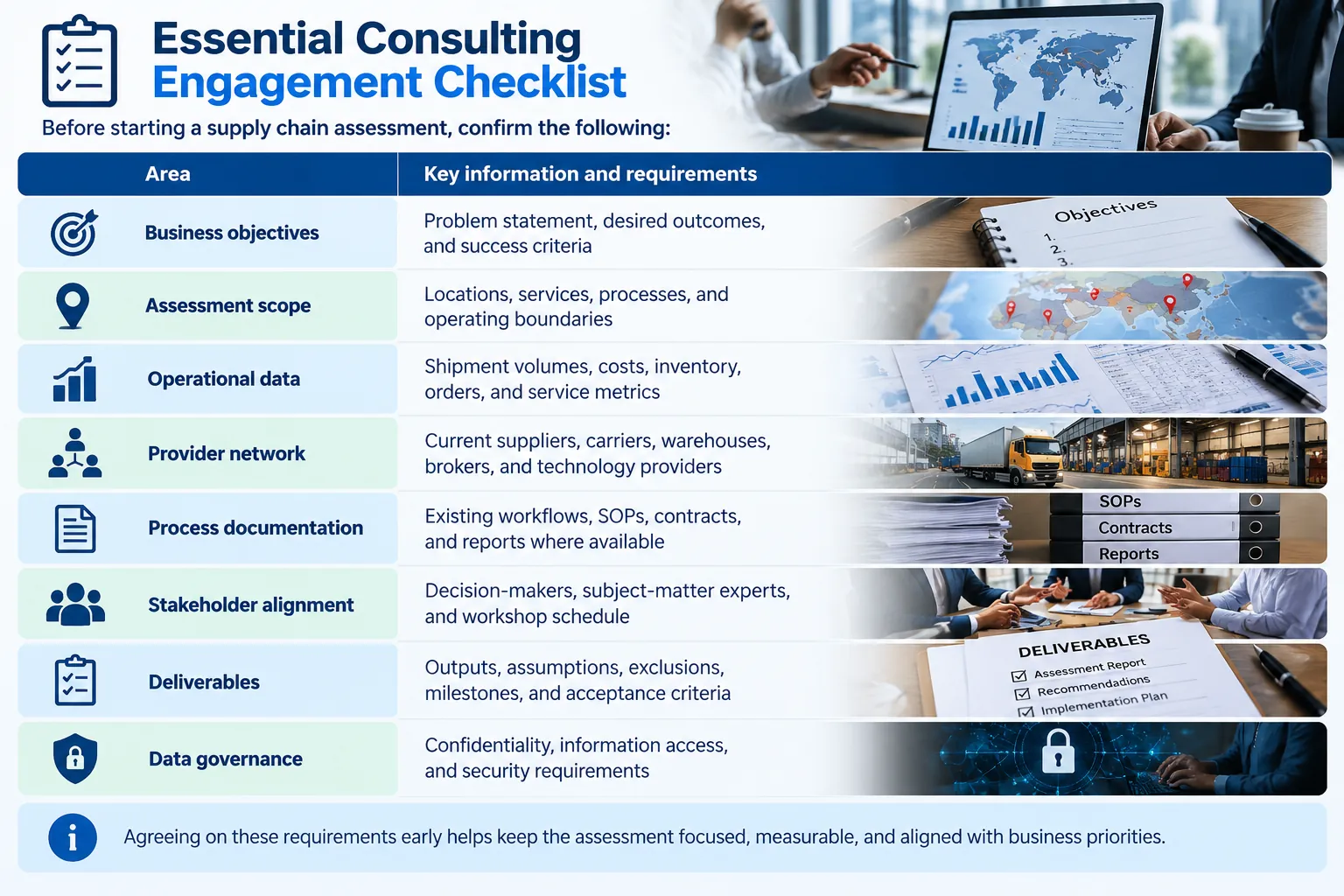
A productive consulting engagement requires accurate information, clear objectives, and timely decisions.
Customers should:
- Define the business objectives, scope, and expected deliverables.
- Provide relevant operational data, process documentation, and access to subject-matter experts.
- Identify applicable legal, tax, regulatory, security, and contractual constraints.
- Review findings and validate assumptions.
- Approve priorities, budgets, recommendations, and implementation responsibilities.
4. ZeNXL's Responsibilities
Depending on the agreed engagement, ZeNXL may be responsible for:
- Defining the assessment approach, deliverables, and scope limitations.
- Reviewing available information and documenting data gaps or assumptions.
- Facilitating stakeholder discussions and mapping relevant processes.
- Developing practical options aligned with the agreed business objectives.
- Presenting findings, risks, dependencies, and recommended next steps.
- Supporting implementation where explicitly included in the engagement.
Recommendations requiring specialist legal, tax, customs, or regulatory interpretation should be reviewed by appropriately qualified advisers.
6. Managing Common Consulting Challenges
Incomplete or inconsistent data: Document the gaps, assess their impact on findings, and agree whether additional data or explicit assumptions are needed.
Conflicting stakeholder priorities: Reconfirm the business objectives, capture competing requirements, and obtain sponsor alignment before finalizing recommendations.
Expanding scope: Document requested changes, assess their impact on deliverables and timing, and obtain approval before proceeding.
Regulatory uncertainty: Identify the relevant issue and refer it to a qualified legal, tax, customs, or regulatory adviser.
Limited implementation resources: Priorities recommendations, identify dependencies, and distinguish proposed improvements from approved and resourced actions.
Unverified savings estimates: Document calculation methods, assumptions, and data limitations. Treat projected benefits as estimates rather than guaranteed outcomes.
7. Frequently Asked Questions
What problems can supply chain consulting address?
Depending on the engagement, it may address logistics costs, warehouse processes, inventory visibility, provider coordination, operating-model design, distribution performance, and market-entry logistics.
Does consulting include implementation?
Not automatically. Assessment, solution design, project management, and implementation support should be defined in the agreed engagement scope.
What data should a business prepare?
Useful information may include shipment volumes, freight invoices, inventory records, warehouse costs, order profiles, service metrics, process documentation, and vendor arrangements.
Can ZeNXL assess India market-entry logistics?
ZeNXL can assess relevant trade and logistics workflows within its expertise. Matters requiring specialist legal, tax, or regulatory advice should be reviewed by qualified advisers.
Are cost savings guaranteed?
No. Results depend on the available data, assumptions, market conditions, implementation, and business decisions. Any projected benefit should state its basis and limitations.
What are the typical consulting deliverables?
Depending on scope, deliverables may include a current-state assessment, gap analysis, operating-model options, prioritized improvement roadmap, KPI framework, and implementation plan.
8. Why Work with ZeNXL?
Supply chain recommendations are most useful when they reflect the realities of day-to-day operations.
ZeNXL brings practical trade and logistics knowledge to the assessment of relevant processes, partner interfaces, warehousing, transportation, and distribution. Our approach focuses on understanding the existing operating model, identifying practical improvement opportunities, and defining clear next steps.
Key areas of focus include:
- Operational assessment: Understanding existing processes and constraints.
- Cost and performance visibility: Identifying relevant cost drivers and performance gaps.
- Practical recommendations: Developing options aligned with business requirements.
- Clear accountability: Defining responsibilities, dependencies, and priorities.
- Implementation planning: Establishing a roadmap for approved improvements.
The objective is to help businesses make better-informed supply chain decisions and build an operating model that supports efficiency and growth.
Need to Solve a Supply Chain Challenge?
Whether you are reviewing logistics costs, improving warehouse operations, coordinating service providers, or planning supply chain operations for expansion into India, ZenXL can help assess your requirements and discuss an appropriately scoped engagement.
Identify Opportunities. Improve Performance. Enable Growth.