

Knowing What Is in Stock Is No Longer Enough
Knowing what you will need next is the real advantage.
Traditional inventory management focuses on tracking stock, recording receipts and dispatches, and maintaining minimum stock levels. But with changing customer demand, multiple warehouses and complex supply chains, businesses need more than accurate stock counts.
They need to know where inventory should be positioned, when it should be replenished and how much stock should be maintained —without tying up unnecessary working capital.
This is where artificial intelligence (AI) can support smarter inventory decisions.
Five Ways AI Can Improve Inventory Management
1. Smarter Demand Forecasting
AI can analyze historical sales, seasonality, customer behavior, promotions, supplier lead times and regional demand patterns to help businesses anticipate demand and adjust inventory plans.
2. Predictive Replenishment
AI-driven systems can recommend when and how much stock to replenish. They can also help identify opportunities to reposition inventory before a stockout occurs.
3. Intelligent Inventory Allocation
For businesses operating multiple warehouses, AI can analyze demand, availability and lead times to support better stock allocation—placing the right products in the right locations.
4. Early Identification of Slow-Moving and Excess Inventory
AI-based analytics can help identify slow-moving products, excess stock, potential obsolescence, unusual demand patterns and products approaching expiry where applicable. This enables earlier corrective action.
5. Better Visibility and Exception Management
AI can help detect unusual inventory movements, system-to-physical stock discrepancies and replenishment risks. Combined with a Warehouse Management System (WMS), barcode scanning and connected operational data, it can support faster investigation and decision-making.
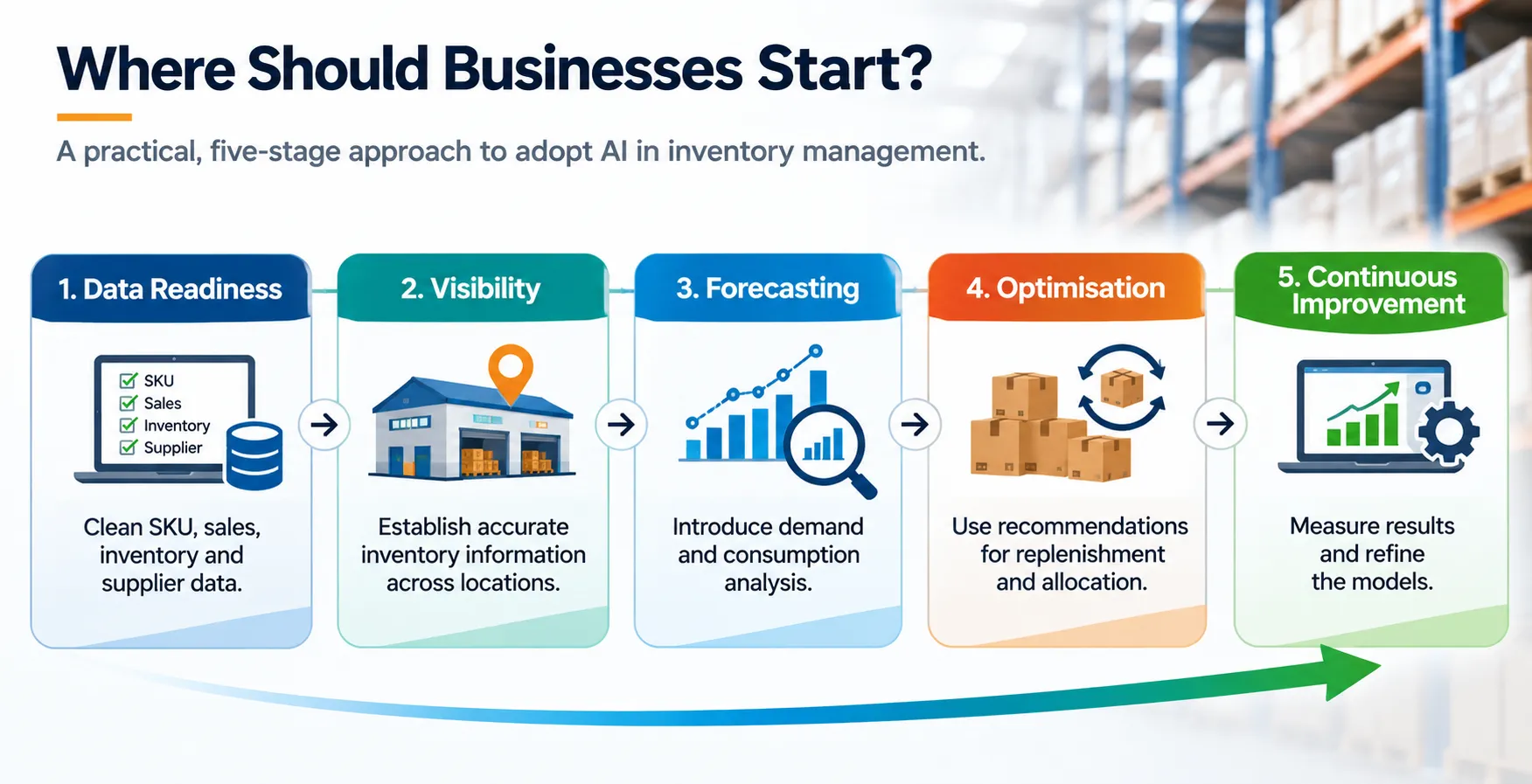
AI Is Only as Good as the Data Behind It
AI does not automatically guarantee better inventory decisions. Inaccurate stock records, incomplete transaction history, inconsistent product codes and unreliable supplier lead times can produce misleading recommendations.
Businesses must also account for sudden market changes, new product launches and exceptional customer requirements.
AI should support inventory managers—not replace operational judgement. Recommendations need to be validated against business rules, supplier constraints and actual stock conditions.
The ZeNXL Perspective
At ZeNXL, we see inventory management as more than a warehouse activity. It connects purchasing, international trade, warehousing, transportation and customer fulfilment.The future of inventory management will be shaped by better data, connected systems and predictive decision-making.
Through technology initiatives such as ZeNXL Trade Flow, our focus is on improving operational visibility, connecting shipment and inventory information, and creating a stronger foundation for data-driven supply chain decisions.
The real value of AI in inventory management is not having more data. It is making better decisions before inventory problems affect customers.
Looking to Improve Inventory Visibility?
Talk to ZeNXL about technology-enabled warehousing and supply chain solutions.