

In-House vs. Outsourced Logistics: Which Operating Model Is Right for Your Business?
Should logistics be a core internal capability or a specialized external service?
Os businesses expand into new markets, logistics becomes increasingly important to their operations. Warehousing, inventory management, transportation, order fulfilment and distribution directly influence customer experience, operating costs and business growth.
What was once considered a back-end operational function is now a strategic business capability.
This raises an important management question: **Should a company build and manage its own logistics infrastructure, or partner with a third-party logistics (3PL) provider?**
There is no universal answer. Both models offer distinct advantages, and the right decision depends on a company's scale, operating requirements, industry, customer expectations and long-term business strategy.
The key is to identify which logistics capabilities should remain under direct business control and where external expertise can create greater efficiency.
Understanding the Two Logistics Operating Models
1. In-House Logistics: Building Internal Capabilities
Under an in-house logistics model, a company owns or directly manages its logistics resources. These may include warehouses, employees, transportation assets, technology platforms and operational processes.
This approach provides greater direct control over daily operations and allows businesses to design logistics processes around their specific requirements.
Key advantages of in-house logistics:
- Greater control over operational decisions and processes.
- Direct ownership of infrastructure, resources and technology.
- Ability to customize logistics operations around business requirements.
- Direct oversight of service quality and customer experience.
However, this control comes with considerable responsibility.
Companies must invest in infrastructure, workforce management, technology, regulatory compliance and ongoing operational improvements. They must also manage capacity, maintenance and the risks associated with changing demand.
For businesses with predictable volumes and highly specialised logistics requirements, these investments may be justified.
2. Outsourced Logistics: Partnering with a Specialist 3PL
Under an outsourced logistics model, a specialist third-party logistics provider manages some or all logistics activities on behalf of a business.
Depending on the agreement, services may include:
- Warehousing and inventory management.
- Transportation and distribution.
- Order processing and fulfilment.
- Import and export coordination.
- Customs clearance coordination.
- Reverse logistics and returns management.
This approach allows businesses to access established infrastructure, operational expertise and logistics technology without necessarily building everything internally.
The primary advantage is flexibility. Companies can potentially scale their logistics capacity, enter new markets and access specialized capabilities while focusing internal resources on their core business activities.
However, outsourcing also requires careful partner selection, clearly defined service-level agreements (SLAs), performance monitoring and effective communication.
Outsourcing operational activities does not eliminate the need for supply chain oversight.
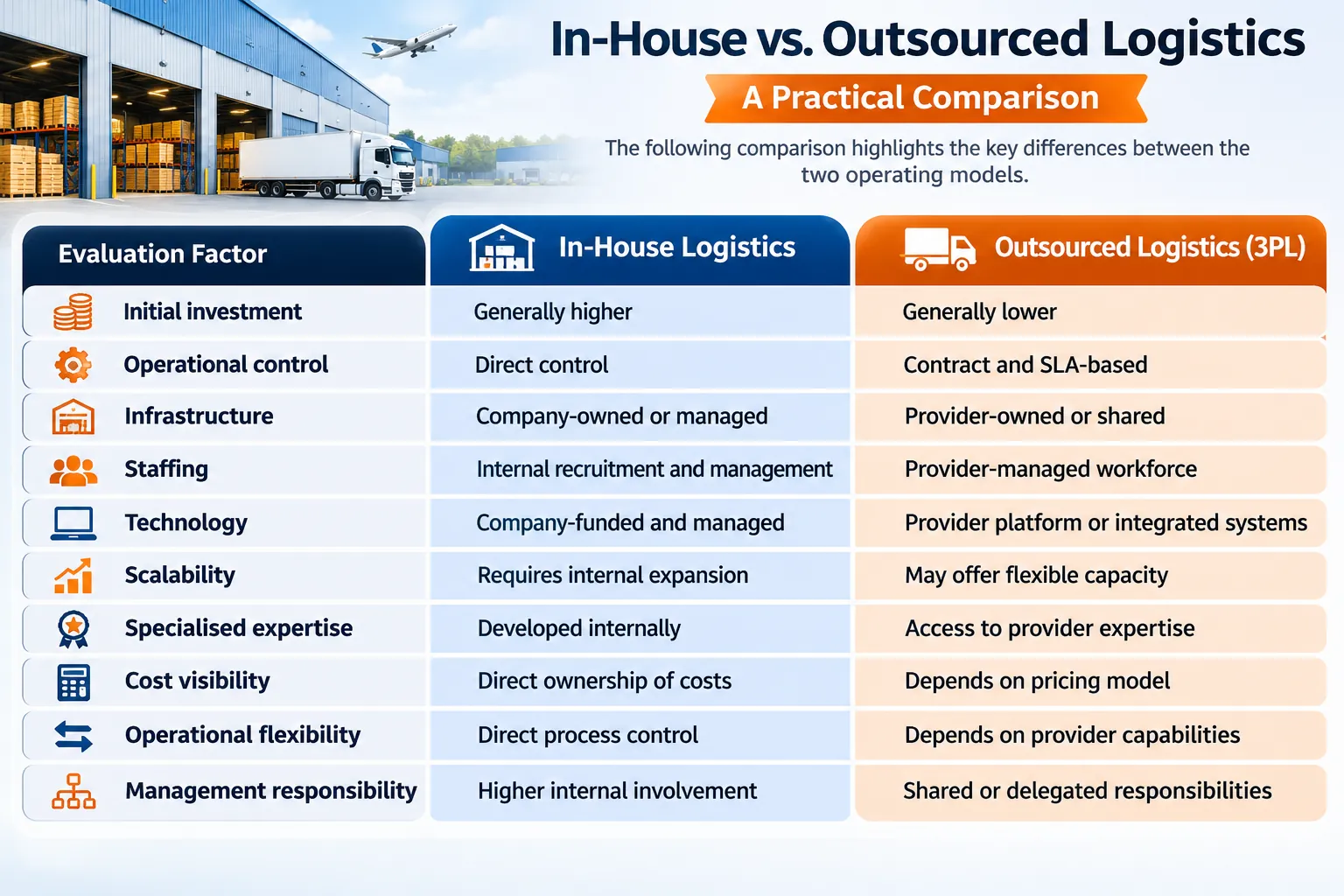
Important: Outsourcing does not automatically guarantee lower logistics costs. The overall cost depends on shipment volumes, service requirements, pricing structures, technology integration and the level of operational complexity.
A meaningful comparison should consider the total cost of ownership (TCO), rather than infrastructure investment alone.
When Should a Business Consider In-House Logistics?
In-house logistics may be appropriate when logistics capabilities are central to a company's competitive advantage.
Businesses may benefit from retaining direct operational control when:
Logistics is a competitive differentiator: The company's delivery model or fulfilment capabilities directly influence its market position.
Operations require specialized processes: Unique handling, security, compliance or inventory requirements demand close internal oversight.
Volumes are substantial and predictable: Consistent demand supports the efficient utilization of infrastructure and resources.
Direct operational control is essential: The business needs immediate decision-making authority over critical logistics activities.
Internal capabilities are well established: The company has the capital, workforce, technology and management expertise required to operate efficiently.
For example, a large manufacturer with predictable production schedules and dedicated distribution requirements may find that an internally managed logistics operation provides the control and consistency it needs.
When Does Outsourcing Logistics Make More Sense?
Outsourcing becomes attractive when a business needs flexibility, specialized expertise or access to established logistics infrastructure.
A 3PL partnership may be particularly valuable when:
Entering new markets or geographies: Accessing an established local network can reduce the complexity of market entry.
Managing seasonal demand: Flexible warehousing and transportation capacity can help accommodate changing volumes.
Reducing capital investment: Businesses can avoid independently establishing every warehouse, transport network or technology platform.
Accessing specialized capabilities: Customs coordination, international logistics and complex distribution requirements may benefit from external expertise.
Focusing on core business activities: Management can concentrate on manufacturing, sales, product development and customer relationships.
For example, a business entering the Indian market may not need to establish its own warehouse, transportation fleet and customs coordination capabilities immediately.
A specialized logistics partner can help establish the required operational network while the business focuses on market development.
The Third Option: A Hybrid Logistics Model
An important consideration often overlooked is that businesses do not necessarily need to choose one model exclusively.
A hybrid logistics model combines internal control with external operational expertise.
This approach allows companies to retain ownership of strategically important logistics activities while outsourcing functions where specialized providers can deliver greater efficiency.
For example:
Manufacturing business
A manufacturer may retain control over production-critical inventory and specialized operations while outsourcing regional warehousing, transportation and distribution.
Global business entering India
A global company may retain ownership of its products, commercial decisions and supply chain strategy while partnering with a local logistics provider to manage import coordination, warehousing and domestic distribution.
Growing e-commerce business
An expanding e-commerce business may manage its central inventory internally while outsourcing regional fulfilment, transportation and returns management to support faster market expansion.
The objective is simple:
Retain control over what matters most. Leverage external expertise where it creates greater value.
This approach can help businesses maintain operational visibility while improving flexibility, efficiency and scalability.
What Should Businesses Evaluate Before Choosing a Logistics Model?
Before deciding between in-house and outsourced logistics, businesses should evaluate the following factors.
Total Cost of Ownership
Consider infrastructure, labor, transportation, technology, maintenance, compliance and management costs.
The lowest initial investment does not necessarily translate into the lowest long-term operating cost.
Operational Control and Visibility
Evaluate how much direct control the business requires over inventory, order fulfilment, transportation and service quality.
A 3PL partnership should provide appropriate visibility into logistics operations through reporting, technology integration and clearly defined responsibilities.
Scalability and Flexibility
Assess whether the logistics model can accommodate future growth, seasonal fluctuations and new market requirements without significant operational disruption.
Technology and Integration
Consider whether the logistics model supports integration with existing ERP, WMS, order management and reporting systems.
**Technology-enabled visibility is essential for maintaining control, regardless of who operates the logistics infrastructure.**
Compliance and Risk Management
Evaluate the regulatory, customs, documentation and operational requirements associated with the business.
For international operations, the ability to coordinate import, export and customs-related activities can be particularly important.
Service Quality and Accountability
Define measurable performance indicators such as inventory accuracy, order fulfilment accuracy, on-time delivery, turnaround time and exception resolution.
Whether logistics is managed internally or externally, accountability should remain clear.
The ZenXL Perspective: Logistics Outsourcing Without Losing Control
At ZenXL, we believe that logistics outsourcing should not mean losing control of your supply chain.
The right logistics partner should function as an extension of your operations, providing visibility, accountability and operational ownership.
Our approach is to connect Importer of Record (IOR) / Exporter of Record (EOR) services, customs coordination, warehousing and transportation to help businesses manage complex logistics requirements through an integrated operating model.
By connecting these capabilities, businesses can reduce the complexity of managing multiple operational interfaces while maintaining visibility into their supply chain.
Whether a business is entering a new market, expanding its distribution network or optimising existing operations, the logistics model should be designed around its specific requirements.
At ZeNXL, we focus on building logistics solutions that support operational efficiency, business growth and supply chain visibility.
Conclusion: Choose the Model That Supports Your Business Growth
The decision between in-house and outsourced logistics is not simply a question of ownership.
It is a strategic decision about how a business allocates resources, manages operational risk, maintains control and supports long-term growth.
In-house logistics can provide greater direct control and customisation. Outsourced logistics can provide access to infrastructure, expertise and flexibility. A hybrid model can combine the advantages of both.
The right logistics operating model is the one that allows your business to grow efficiently without compromising control, service quality or customer experience.