

Entering India requires more than shipping products across the border. Businesses need to understand the appropriate import structure, product classification, customs documentation, applicable taxes, regulatory requirements, inventory arrangements, and domestic distribution.
For companies without an established Indian operating structure—or those looking to simplify their existing operations—an Importer of Record (IOR) and Exporter of Record (EOR) service arrangement may help address specific trade and compliance requirements.
Zenxl helps businesses coordinate international trade and logistics through an integrated operating model that can include import planning, documentation coordination, customs clearance, warehousing, transportation, and final delivery, depending on the agreed scope.
The right approach starts with understanding your products, business objectives, transaction structure, and responsibilities before the shipment moves.
In this guide, you will learn:
- What IOR and EOR mean and when these services may be needed.
- How ZeNXL coordinates an import into India, step by step.
- The difference between a non-owner/intermediary model and a model where Zenxl takes title to goods and resells them.
- What documents, approvals, and information are required.
- How responsibilities, exceptions, and shipment closure are managed.
1. What Are IOR and EOR Services?
Importer of Record (IOR)
The Importer of Record is the party identified as the importer for the relevant customs transaction and responsible for applicable import obligations under the governing rules and arrangements.
Depending on the transaction, these obligations can include import declarations, supporting documentation, customs duties and taxes, and compliance with applicable import restrictions and regulatory requirements.
An IOR arrangement can help an international business establish a workable route for importing eligible goods into India. However, the appropriate structure must be confirmed for the specific goods and transaction. Using a service provider does not automatically remove the customer's own legal, tax, or regulatory obligations.
Exporter of Record (EOR)
The Exporter of Record is the party responsible for the relevant export declaration and applicable export obligations for a shipment leaving a country.
EOR services may be relevant when goods need to be exported from India, and the parties require support with export documentation, customs formalities, and coordination with logistics providers.
The appropriate exporter, licensing arrangements, tax treatment, and documentation must be confirmed for each transaction.
How ZeNXL supports international trade:
ZeNXL coordinates the agreed trade and logistics activities to help businesses move goods through the required stages with greater visibility and control.
Depending on the engagement, services may include:
- Import and export operating-model assessment.
- Product and shipment information collection.
- Documentation and regulatory requirement coordination.
- Customs broker and logistics partner coordination.
- Warehousing, inventory management, and domestic distribution.
- Shipment reporting, billing coordination, and exception management.
The exact scope depends on the agreed service model, product eligibility, contractual responsibilities, and applicable regulations.
2. Choose the Right Import Operating Model
Before arranging an international shipment, the parties must establish who will import the goods, who owns them, who sells them, and how payment and inventory will be managed.
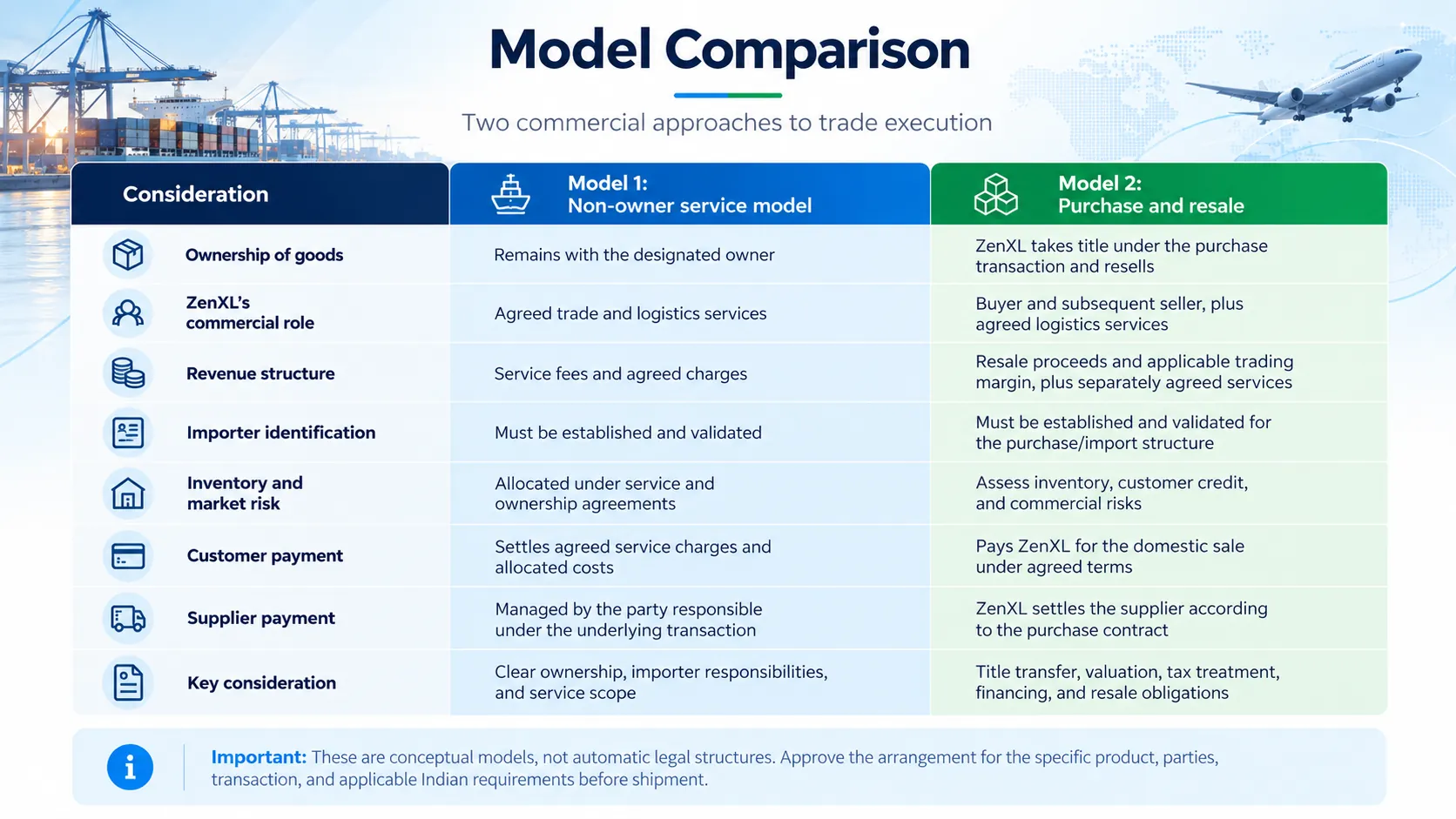
Zenxl can assess two broad commercial models, subject to legal, customs, tax, and regulatory validation.
Model 1: Zenxl coordinates the import without taking ownership of the goods:
The commercial principle: Zenxl provides agreed import and logistics services, while ownership of the goods remains with the customer or another designated party. Zenxl does not buy the goods for resale under this model.
A simplified flow:
Overseas Supplier → India Import Structure → Customs Clearance → Zenxl Warehouse, if required → Indian Customer
The legal importer must be explicitly identified and validated. If Zenxl is proposed to act as the IOR, the parties must confirm that Zenxl can lawfully undertake that role for the particular transaction. Not taking title to the goods does not, by itself, eliminate the legal responsibilities attached to acting as the importer.
How the model works
- The overseas supplier prepares the goods and commercial documents.
- The parties confirm the importer, ownership arrangements, consignee, and commercial responsibilities.
- Zenxl coordinates the agreed import documentation, service providers, and shipment arrangements.
- The responsible importer and customs broker complete the applicable import declaration and clearance requirements.
- After customs release, the goods are delivered to the designated warehouse or final destination.
- If warehousing is included, inventory is recorded and managed under the agreed process.
- Zenxl coordinates the agreed delivery, service billing, document reconciliation, and shipment closure.
Commercial and operational characteristics:
- Zenxl charges for the agreed services rather than purchasing and reselling the goods.
- Goods ownership remains with the designated owner under the contract.
- The parties agree how import costs, taxes, duties, and logistics charges are funded and settled.
- Customer sales to the Indian end customer, where applicable, remain separate from Zenxl's service arrangement unless otherwise agreed.
- The contract must specify the importer, owner, consignee, payment responsibilities, and party accountable for each compliance requirement.
Best suited for: Businesses that want to retain ownership and control of their goods while outsourcing specified import coordination and logistics activities.
Model 2: Zenxl takes title to the goods and resells them in India
The commercial principle: Zenxl purchases or otherwise takes legal title to the goods under a documented transaction and subsequently resells them to the Indian customer. The overseas supplier is paid according to the agreed supplier contract and settlement arrangement.
A simplified flow:
Overseas Supplier → Zenxl's Purchase Transaction → Import Clearance → Zenxl Warehouse, if required → Indian Customer
How the model works:
- Commercial agreement: The parties define the goods, purchase price, resale arrangement, delivery terms, payment terms, and allocation of risks.
- Supplier purchase: Zenxl enters into the agreed purchase transaction and obtains the necessary commercial documentation.
- Import assessment: The parties validate the importer, product eligibility, customs valuation, classification, applicable duties and taxes, and any other regulatory requirements.
- Shipment and clearance: The supplier ships the goods, and the responsible parties coordinate import declarations and customs clearance.
- Receipt and inventory: After release, the goods are received at the agreed location, with inventory records maintained as applicable.
- Domestic sale and delivery: Zenxl sells the goods to the Indian customer under the agreed resale terms and coordinates delivery.
- Customer invoicing and collection: Zenxl invoices the Indian customer according to the commercial agreement and applicable requirements.
- Supplier settlement: Zenxl pays the overseas supplier according to the supplier contract. If payment is intended to occur after Zenxl receives payment from the Indian customer, this dependency must be explicitly agreed and reviewed for commercial, tax, accounting, foreign-exchange, and other applicable requirements.
- Transaction closure: The parties reconcile relevant documents, costs, inventory, payments, and outstanding exceptions.
Commercial and operational characteristics
- Zenxl takes title to the goods under the documented transaction.
- Zenxl acts as seller in the subsequent domestic sale, subject to the agreed arrangement and applicable law.
- Purchase price, resale price, working-capital exposure, inventory risk, and customer credit risk must be assessed.
- Import valuation, applicable taxes, invoicing, accounting, and foreign-exchange settlement require appropriate review.
- The contracts must clearly establish when title and risk transfer and what happens if the customer delays payment, rejects goods, or cancels an order.
Best suited for: Transactions where a purchase-and-resale structure is commercially appropriate and the parties have approved the associated legal, tax, compliance, and working-capital implications.
How ZeNXL's IOR Process Works:
ZeNXL's process is designed to identify requirements before shipment, coordinate the relevant parties during import, and maintain visibility through delivery and closure.
Step 1 — Understand the business and shipment requirements
ZeNXL begins by understanding the customer's business objective and the shipment's specific requirements.
Information typically collected includes:
- Product description, model, intended use, and country of origin.
- Supplier, buyer, consignee, and delivery location.
- Shipment quantity, value, weight, dimensions, and expected shipping date.
- Proposed ownership and import operating model.
- Required delivery timeline and any warehousing or distribution needs.
ZeNXL's role: Collect the relevant information, identify missing details, and coordinate the initial assessment.
Customer's role: Provide accurate product, commercial, supplier, consignee, and delivery information.
Outcome: A documented shipment profile and an initial list of items requiring confirmation.
Step 2 — Assess the import structure and responsibilities
Before shipment, the parties establish the proposed transaction structure and the roles of the supplier, owner, importer, buyer, customs broker, and logistics providers.
The assessment considers:
- Whether the proposed importer and operating model are appropriate.
- Whether the goods can be imported under the proposed arrangement.
- Who owns the goods at each stage.
- Who is responsible for import declarations, duties, taxes, and other obligations.
- Whether licenses, registrations, permits, or product-specific approvals may be required.
- Whether the proposed commercial and payment terms are workable.
ZeNXL's role: Coordinate the operating-model assessment and identify matters requiring specialist or customer approval.
Customer's role: Confirm the commercial objective, ownership arrangements, and relevant product and business information.
Outcome: An agreed operating model with responsibilities and outstanding approvals documented before shipment.
Step 3 — Review product classification and documentation
Correct product classification and complete supporting documentation are essential to the import process.
The review may include:
- Product description and technical specifications.
- Applicable HS classification.
- Country of origin and supporting evidence.
- Commercial invoice and packing list.
- Product-specific licences, declarations, certificates, or approvals, where required.
- Customs valuation information and applicable duty and tax considerations.
- Labelling, marking, or other regulatory requirements, where applicable.
Applicable import charges may include Basic Customs Duty (BCD), Social Welfare Surcharge (SWS), IGST, and other levies or components where legally applicable. The applicability and calculation of each item depend on the product, classification, exemption eligibility, and current rules.
ZeNXL's role: Coordinate document collection and review with the relevant customs broker or specialist, within the agreed scope.
Customer's role: Supply accurate technical and commercial information and obtain any approvals or certifications that are its responsibility.
Outcome: A document set ready for the agreed pre-shipment checks, with unresolved classification or compliance questions escalated.
Step 4 — Confirm shipment readiness
Once the operating model and documentation have been reviewed, the parties confirm that the shipment is ready to proceed.
This may involve:
- Confirming supplier readiness and dispatch details.
- Checking that required documentation and approvals are available.
- Coordinating the transport booking and shipping instructions.
- Confirming the expected arrival date and delivery requirements.
- Establishing who will fund or pay applicable import charges.
- Confirming the receiving location and any warehouse requirements.
ZeNXL's role: Coordinate readiness checks and communicate outstanding actions to the relevant parties.
Customer's role: Approve the shipment, provide missing information, and meet agreed funding and documentation requirements.
Outcome: A documented readiness status and an agreed plan for shipment execution.
Step 5 — Coordinate customs clearance
When the shipment arrives, the responsible importer and customs broker complete the required customs formalities.
Depending on the transaction, activities may include:
- Reviewing arrival and shipping documents.
- Preparing and submitting the relevant customs declaration.
- Providing supporting documents and responding to customs queries.
- Arranging payment of applicable duties and taxes.
- Coordinating examination, testing, or other regulatory requirements if directed.
- Monitoring clearance progress and communicating exceptions.
ZeNXL's role: Coordinate the agreed parties, track progress, and communicate outstanding requirements and shipment status.
Customer's role: Provide additional product information, declarations, approvals, or funds when required under the agreed arrangement.
Outcome: Customs release when the applicable requirements have been satisfied.
Customs authorities determine whether additional information, examination, assessment, or other action is required. No service provider can guarantee clearance timing or a particular customs decision.
Step 6 — Receive and manage inventory
After customs release, the goods are delivered to the designated destination. If warehousing is included in the engagement, the receiving process may include:
- Recording arrival and receipt details.
- Checking quantities and visible condition against the available documents.
- Recording discrepancies, damage, or shortages.
- Assigning storage locations and updating inventory records.
- Applying agreed lot, serial-number, or other tracking requirements.
- Reporting receipt status and exceptions to the customer.
ZeNXL's role: Manage or coordinate receiving and inventory activities included in the contracted service scope.
Customer's role: Confirm inventory requirements, handling instructions, and the appropriate process for resolving discrepancies.
Outcome: Receipt visibility and inventory records aligned with the agreed process.
Step 7 — Coordinate domestic delivery
Once the goods are cleared and ready for dispatch, Zenxl coordinates delivery according to the agreed instructions.
Activities may include:
- Confirming the delivery address and recipient.
- Planning the transport movement.
- Coordinating dispatch and shipment documentation.
- Tracking delivery status.
- Obtaining proof of delivery or other agreed confirmation.
- Reporting shortages, damage, failed delivery attempts, or delays.
ZeNXL's role: Coordinate the agreed transportation and delivery activities and communicate exceptions.
Customer's role: Provide accurate delivery instructions, recipient details, access requirements, and any necessary approvals.
Outcome: Delivery confirmation and updated shipment status.
Step 8 — Reconcile, report, and close the shipment
The final stage brings the operational and commercial records together.
Depending on the engagement, closure may include:
- Confirming delivery and receiving records.
- Reconciling relevant shipping and service documents.
- Reviewing agreed service charges and other allocated costs.
- Issuing or checking invoices under the agreed arrangement.
- Reconciling inventory or outstanding discrepancies, where applicable.
- Closing open exceptions or assigning remaining actions.
- Providing the agreed shipment summary or management report.
ZeNXL's role: Complete the agreed operational reporting, billing coordination, and exception follow-up.
Customer's role: Review invoices and records, raise discrepancies within agreed timelines, and settle amounts according to the contract.
Outcome: A documented shipment closure with outstanding items identified and assigned.
4. Customer Responsibilities for Importing into India
Successful imports require accurate documentation, clear responsibilities, and timely approvals. To ensure smooth IOR/EOR services and customs clearance in India, customers should provide:
Business & commercial details: Buyer and supplier information, legal entity details, transaction structure, and relevant agreements.
Product & compliance documents: Product specifications, HS classification (if available), country of origin, and applicable licenses, certificates, or registrations.
Shipping documents: Commercial invoice, packing list, shipment dimensions, consignee details, delivery address, and required timelines.
Approvals & payments: Confirmation of the import model, allocation of duties and taxes, freight and other charges, and all required pre-shipment approvals.
Best practice: Confirm the import structure, compliance requirements, documentation, and responsibilities before dispatching goods to India.
5. ZenXL’s Responsibilities: From Import Coordination to Delivery
ZenXL coordinates agreed IOR/EOR services, customs clearance, transportation, and warehousing based on the service agreement and shipment requirements.
Planning & onboarding: Assess business requirements, define the operating model, and establish documentation and approval needs.
Customs & trade coordination: Coordinate documents, liaise with customs brokers and specialists, track clearance, and escalate compliance issues.
Logistics & warehousing: Coordinate transportation, delivery, receiving, inventory management, and dispatch were included in scope.
Reporting & closure: Provide shipment updates, maintain operational records, coordinate billing, and track outstanding issues.
Important: ZenXL’s responsibilities depend on the agreed service scope. Legal obligations of the importer, exporter, goods owner, and other parties remain subject to applicable Indian laws and contractual arrangements.
6. Import Documents Checklist for India
The documents required for importing goods into India depend on the product, shipment, importer, and transaction structure. Use this checklist as a starting point.
Commercial & shipping documents: Commercial invoice, packing list, purchase order or contract, transport document (air waybill or bill of lading), and consignee details.
Product & regulatory documents: Product specifications, HS classification, country-of-origin evidence, applicable licenses, permits, certificates, and test reports.
Importer & transaction documents: Importer registrations and authorizations, ownership and transaction details, agreed commercial terms, and allocation of customs, tax, and logistics responsibilities.
Clearance & delivery records: Customs declarations, applicable payment records, warehouse receipts, inventory records, proof of delivery, and final cost reconciliation.
Important: Not every document applies to every shipment. Confirm product-specific requirements, importer eligibility, and applicable Indian regulations with ZeNXL and the designated customs broker before dispatch.
7. Managing Import Exceptions in India
International shipments can face documentation gaps, customs delays, regulatory queries, payment issues, or delivery discrepancies. ZenXL coordinates with the relevant parties to track exceptions, communicate impacts, and support resolution within the agreed service scope.
Missing documents: Identify gaps, obtain corrections, and update shipment timelines.
Product or regulatory queries: Coordinate technical information and specialist review before proceeding.
Customs delays or examinations: Track outstanding requirements and revise delivery plans where necessary.
Duty, tax, or payment issues: Confirm payment responsibilities, approvals, and funding status.
Damage or inventory discrepancies: Record evidence, notify stakeholders, and follow the agreed resolution process.
Delivery failures: Coordinate revised delivery instructions and record the outcome.
Commercial disputes: Follow the agreed purchase, resale, payment, and claims procedures.
Best practice: Assign an owner, next action, status, and escalation path to every material exception. Cost responsibility and resolution remain subject to the contract and applicable law.
8. Frequently Asked Questions About IOR/EOR in India
1. Can a foreign company import into India without establishing an Indian entity?
Potentially, depending on the product, transaction structure, and applicable regulations. IOR arrangements do not automatically remove all local registration or licensing requirements.
2. What is the difference between an Importer of Record and a customs broker?
The importer is responsible for applicable import obligations, while a customs broker assists with customs procedures within its authorized role. Using a broker does not automatically transfer the importer's legal responsibilities.
3. Can ZeNXL manage imports without owning the goods?
Potentially, where the transaction structure and applicable rules permit it. Ownership, importer status, contractual responsibilities, and compliance obligations must be clearly established.
4. What is the purchase-and-resale import model?
Under this model, ZeNXL may purchase goods from an overseas supplier and resell them to an Indian customer under an agreed commercial arrangement. This requires assessment of inventory, payment, tax, valuation, and working-capital implications.
5. Can supplier payments be made after receiving customer payments?
Payment arrangements depend on contractual terms and applicable foreign-exchange, banking, tax, and accounting requirements. They must be reviewed before implementation.
6. What import duties and taxes apply in India?
Depending on the product and applicable rules, charges may include Basic Customs Duty (BCD), Social Welfare Surcharge (SWS), and Integrated GST (IGST). Rates depend on classification, origin, exemptions, and rules in force at import.
7. How long does customs clearance take in India?
Timelines depend on documentation, product approvals, customs assessment, examinations, payment readiness, and transport arrangements. Clearance timelines cannot be guaranteed.
8. Can ZeNXL provide warehousing and domestic delivery?
Subject to location, availability, and agreed scope, ZeNXL can coordinate warehousing, inventory management, transportation, and final delivery after clearance.
9. What happens if customs request additional documents?
The responsible parties must provide the required information or follow the prescribed procedure. ZeNXL can coordinate with the customer, importer, and customs broker within the agreed scope.
10. Does ZeNXL guarantee customs clearance?
No. Clearance decisions rest with the relevant authorities. ZeNXL can coordinate documentation, logistics, and follow-up, but outcomes depend on applicable requirements and official decisions.
11. Can ZeNXL support exports from India?
Subject to product eligibility and the transaction structure, ZeNXL can assess export documentation, customs coordination, and logistics requirements.
12. What information is needed to get started?
Provide the product description, country of origin, supplier and consignee details, shipment value and quantity, delivery location, expected timeline, and proposed ownership or commercial model. An invoice, packing list, or product specification can support the initial assessment.
9. Why Choose ZeNXL for IOR/EOR and Import Logistics?
International trade involves interconnected commercial, regulatory, customs, and logistics requirements. ZeNXL helps businesses coordinate these activities through a structured, integrated approach.
Structured planning: Define requirements, documentation, and responsibilities.
Coordinated execution: Connect customers, suppliers, customs brokers, warehouses, and transport providers.
Operational visibility: Track shipment status, outstanding actions, and exceptions.
Integrated logistics: Connect imports with warehousing, transportation, and domestic distribution where required.
Transaction-specific assessment: Evaluate the proposed import model and associated responsibilities before shipment.
Our objective is to simplify coordination while ensuring each party understands its obligations.