

Efficient transportation is essential to keeping supply chains moving. From collecting goods at the point of origin to delivering them to warehouses, distribution centers, and customers, every shipment requires the right transport option, careful coordination, and clear communication.
The right solution depends on shipment size, urgency, cargo characteristics, route, budget, and delivery requirements.
ZeNXL coordinates transportation and freight solutions within the agreed service scope, potentially including road freight, Full Truckload (FTL), Less-than-Truckload (LTL), express movements, air freight, ocean freight, and multimodal transport through appropriate carriers and logistics partners.
1. What Are Transportation and Freight Services?
Transportation and freight services involve planning and coordinating the movement of goods between suppliers, warehouses, distribution points, and customers.
Depending on the shipment requirements, businesses may use:
- Road Freight: Transportation for domestic cargo movements.
- FTL (Full Truckload): A vehicle dedicated to a shipment or customer load.
- LTL (Less-than-Truckload): Consolidation of smaller shipments with other freight.
- Express Transportation: Priority movements for time-sensitive shipments.
- Air Freight: An option for suitable international or domestic shipments where speed is important.
- Ocean Freight: A transport option for suitable international cargo.
- Multimodal Transport: Combining different transportation modes to meet shipment requirements.
The appropriate option depends on cost, transit time, cargo characteristics, capacity, route, and handling requirements.
2. How ZeNXL's Transportation Process Works
A structured transportation process helps coordinate shipments from booking through delivery.
Step 1: Understand the Shipment
The shipment requirements are reviewed, including origin, destination, cargo description, dimensions, weight, packaging, required delivery timing, and any special handling conditions.
Step 2: Select the Transport Option
Suitable transportation options are assessed against urgency, cost, capacity, route, cargo requirements, and expected transit time.
Step 3: Confirm the Quote and Service Scope
The quotation should clarify the agreed rate, inclusions, exclusions, additional charges, estimated transit time, booking conditions, and responsibilities for loading, unloading, insurance, and documentation.
Step 4: Book the Carrier and Plan Dispatch
Carrier availability, pickup schedules, loading arrangements, shipment references, and required transport documents are coordinated.
Step 5: Verify Shipment Readiness
Before collection, the cargo should be appropriately packed, labelled, documented, and ready for pickup. Missing information or unsuitable packaging should be addressed before dispatch.
Step 6: Coordinate Pickup and Transportation
The shipment is collected and handed over to the designated carrier. Relevant movement milestones are recorded, and material changes are communicated to the concerned parties.
Step 7: Track Shipments and Manage Exceptions
Where tracking is available, shipment status is monitored. Delays, missed pickups, route changes, cargo damage, and delivery constraints are followed up with the responsible parties.
Step 8: Confirm Delivery and Close the Shipment
Delivery confirmation or proof of delivery is collected where available. Agreed charges are reviewed where applicable, and outstanding claims or exceptions are documented for follow-up.
3. Customer Responsibilities
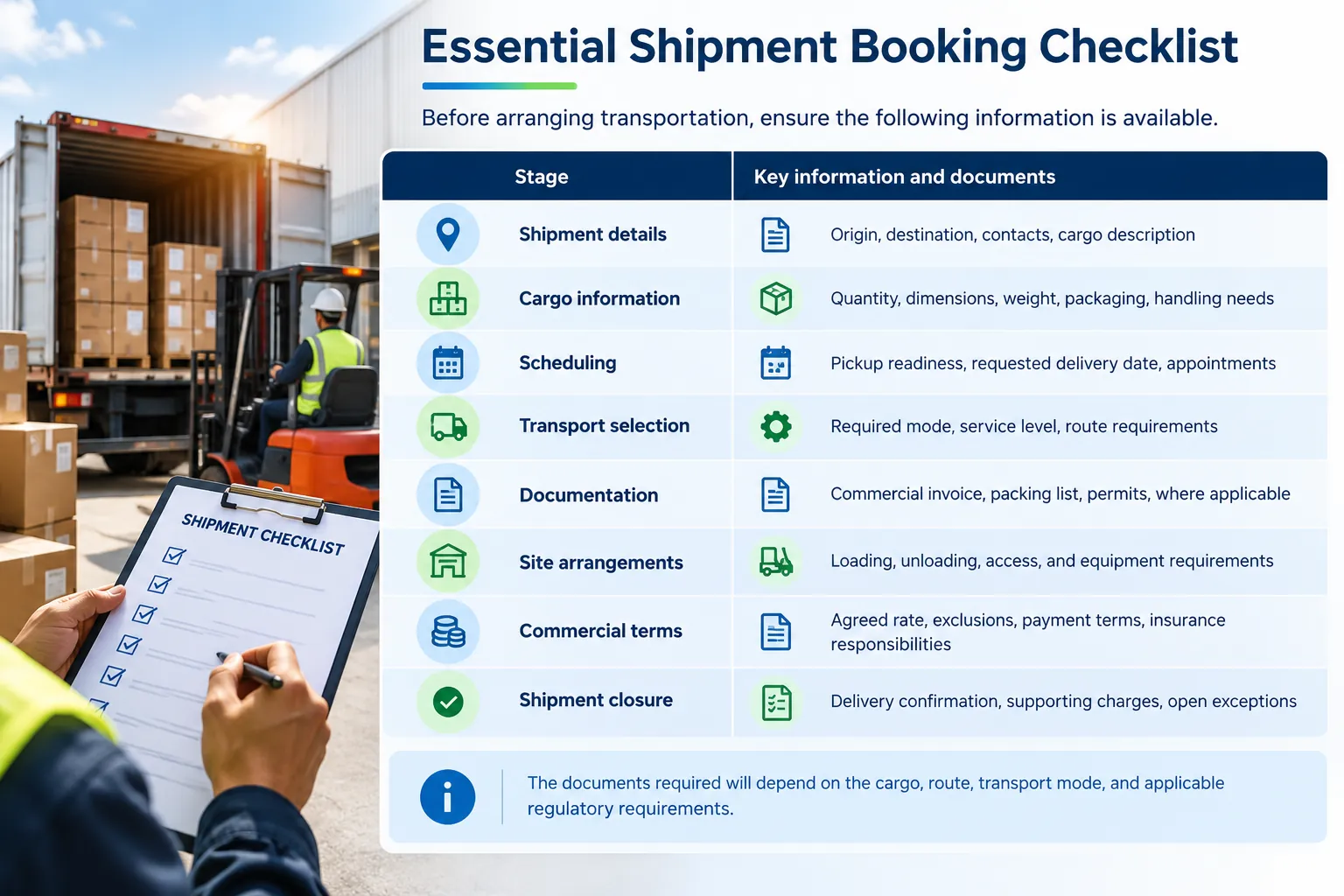
Accurate shipment information helps prevent booking errors, pickup delays, and unexpected charges.
Customers should provide:
Shipment details
- Origin and destination addresses with contact information
- Cargo description, quantity, weight, and dimensions
- Packaging and handling requirements
- Requested pickup date and delivery deadline
Special requirements
- Dangerous goods or restricted cargo details, where applicable
- Temperature-controlled or oversized cargo requirements
- Loading, unloading, equipment, and site-access arrangements
- Delivery appointments and recipient instructions
Commercial and documentation requirements
- Commercial invoices, packing lists, and other applicable documents
- Relevant permits, customs, or regulatory documentation
- Agreed rates, payment terms, and insurance responsibilities
- Authorized contacts and escalation details
Special cargo requirements should be disclosed before booking so that the proposed transport arrangement can be assessed appropriately.
4. ZeNXL's Responsibilities
Depending on the contracted scope, ZeNXL may be responsible for:
- Assessing shipment requirements and coordinating suitable transport options
- Coordinating carrier bookings and pickup and delivery instructions
- Communicating relevant shipment milestones and material delays
- Following up on transportation exceptions with the relevant parties
- Providing agreed status updates and delivery evidence where available
- Supporting freight invoice review and exception follow-up were included
The applicable service model, carrier arrangements, tracking availability, and responsibilities should be confirmed for each engagement
6. Managing Common Transportation Challenges
Pickup or capacity delays: Identify the cause, check available alternatives, communicate the impact, and agree on a revised pickup plan.
Transit delays or missed connections: Obtain an updated carrier status, assess the effect on delivery, and coordinate the next steps.
Cargo damage or shortages: Record the condition and quantities, preserve photographs and relevant documents, notify the appropriate parties, and follow the agreed claims process.
Incorrect address or failed delivery: Verify recipient details, obtain updated instructions, and confirm potential redelivery or waiting charges where feasible.
Unexpected freight charges: Compare the charges with the quotation and agreed terms, request supporting details, and escalate disputed items for review.
Tracking gaps: Request an update from the responsible carrier and communicate the limits of available tracking information.
Clear communication and documented follow-up help manage disruptions and maintain accountability throughout the shipment lifecycle.
7. Frequently Asked Questions
What is the difference between FTL and LTL?
FTL generally reserves a vehicle for one shipment or customer load, while LTL combines smaller shipments with other freight. The appropriate option depends on cargo volume, route, urgency, handling, and cost.
Can ZeNXL coordinate air and ocean freight?
ZeNXL can coordinate international freight through relevant logistics partners where the required route, capabilities, and service scope are confirmed.
Does ZeNXL own its transportation fleet?
The operating model may involve third-party carriers or other transportation resources. The applicable arrangement should be clarified in the service proposal.
Can transportation delivery times be guaranteed?
Transit times depend on route, carrier capacity, weather, customs or border processes, and other operating conditions. Any binding delivery commitment must be expressly agreed.
Who is responsible for cargo insurance?
Insurance responsibility depends on the contract and shipment terms. The parties should confirm whether cover is arranged, who arranges it, and which risks or exclusions apply.
What information is required for a freight quote?
Provide the origin, destination, cargo description, dimensions, weight, pickup readiness, required delivery timing, handling requirements, and any special conditions.
8. Why Work with ZeNXL?
Effective transportation involves more than booking a vehicle. It requires selecting a suitable transport option, coordinating carrier handovers, communicating shipment changes, and maintaining clear records.
ZeNXL connects transportation coordination with warehousing and broader logistics services where included in the agreed scope.
Our approach focuses on:
Shipment planning: Assessing transport options against cargo and delivery requirements.
Coordinated execution: Aligning bookings, pickups, and delivery instructions.
Shipment visibility: Providing agreed status updates and delivery confirmation where available.
Exception management: Following up on delays, discrepancies, and other shipment issues.
Integrated logistics: Connecting transportation with warehousing and supply chain operations where required.
The objective is to help businesses coordinate freight movements with clearer responsibilities and better operational control.
Need a Transportation Solution?
Whether you need domestic road freight, FTL or LTL transportation, express movements, or coordination of international freight, ZeNXL can help assess suitable options for your shipment requirements.
Share your origin, destination, cargo profile, required timing, and handling needs with our team so we can understand your requirements and discuss the appropriate service model.
Move with Confidence. Deliver with Control.