

How Warehouse Operations Work: From Inbound Receiving to Final Delivery
Efficient warehouse operations are essential for maintaining inventory accuracy, fulfilling customer orders, and ensuring timely product delivery.
Modern warehousing goes beyond storing goods. It connects inbound receiving, inventory management, storage, order fulfillment, dispatch, and distribution into one coordinated supply chain process.
For businesses managing multiple products, locations, and distribution channels, an organised warehouse operation helps reduce stock discrepancies, improve operational visibility, and control logistics costs.
At ZenXL, we provide warehousing and fulfillment solutions designed to simplify inventory management, streamline order processing, and support efficient distribution.
This guide explains how warehouse operations work, the responsibilities involved, and the key processes that keep inventory moving.
1. What Are Warehousing and Fulfillment Services?
Warehousing involves receiving, storing, safeguarding, and managing inventory within a designated facility.
Order fulfillment covers the process of receiving customer orders, picking products, packing shipments, and preparing goods for dispatch and delivery.
Together, these services help businesses manage inventory and respond efficiently to customer demand.
Key warehousing and fulfillment activities include:
- Inbound receiving and goods verification
- Storage and warehouse location management
- Inventory tracking and stock reconciliation
- Order processing, picking, and packing
- Dispatch and transportation coordination
- Operational reporting and exception management
Businesses can outsource these activities through third-party logistics (3PL) warehousing services, allowing them to focus on their core operations while a logistics partner manages agreed warehouse functions.
2. How Warehouse Operations Work: Step by Step
A structured warehouse process ensures that products move efficiently from arrival to final dispatch.
Step 1: Warehouse Planning and Customer Onboarding
The process begins by understanding the customer's products, storage requirements, expected inventory volumes, order frequency, and distribution needs.
This includes establishing SKU masters, product dimensions, handling instructions, inventory tracking requirements, and operational procedures.
Outcome: A defined warehouse operating model aligned with business requirements.
Step 2: Inbound Receiving and Goods Verification
When goods arrive at the warehouse, the receiving team verifies shipments against available delivery documents and agreed procedures.
Typical checks include:
- Product identification and SKU verification
- Package and quantity checks
- Visible damage inspection
- Batch or serial-number recording, where required
- Identification of shortages, excess stock, or discrepancies
Any exceptions are documented and communicated for resolution.
Outcome: Accurate receiving records and better control over incoming inventory.
Step 3: Storage and Inventory Management
After verification, products are assigned to designated storage locations based on their size, handling needs, and warehouse layout.
Inventory records are updated to reflect stock quantities, locations, and status.
Depending on the operating model, inventory controls may include barcode tracking, bin-level visibility, batch or serial tracking, and periodic stock counts.
Outcome: Organized storage, improved stock visibility, and more efficient inventory retrieval.
Step 4: Order Processing and Stock Allocation
Customer orders are received through agreed communication channels or system integrations.
Orders are reviewed for product availability, quantities, delivery instructions, and dispatch priorities.
Where inventory is insufficient or restricted, the issue is flagged for customer review.
Outcome: Validated orders ready for fulfillment.
Step 5: Picking, Packing, and Order Verification
Warehouse personnel pick the required products from their assigned storage locations and prepare them for shipment.
Activities may include:
- SKU and quantity verification
- Product picking and consolidation
- Packaging and labelling
- Shipment documentation
- Final dispatch checks
Outcome: Orders accurately prepared for transportation.
Step 6: Dispatch and Transportation Coordination
Prepared shipments are handed over to the designated transportation provider.
Depending on the agreed service scope, dispatch activities may include transport scheduling, shipment tracking, delivery updates, and proof-of-delivery coordination.
Outcome: Coordinated movement of goods from warehouse to destination.
Step 7: Inventory Reconciliation and Reporting
Warehouse operations require ongoing monitoring to maintain inventory accuracy and service performance.
Regular reporting may include stock-on-hand, inbound receipts, outbound orders, inventory discrepancies, and dispatch status.
Cycle counts and physical stock verification help identify discrepancies that require investigation and authorised correction.
Outcome: Better inventory control, operational visibility, and continuous improvement.
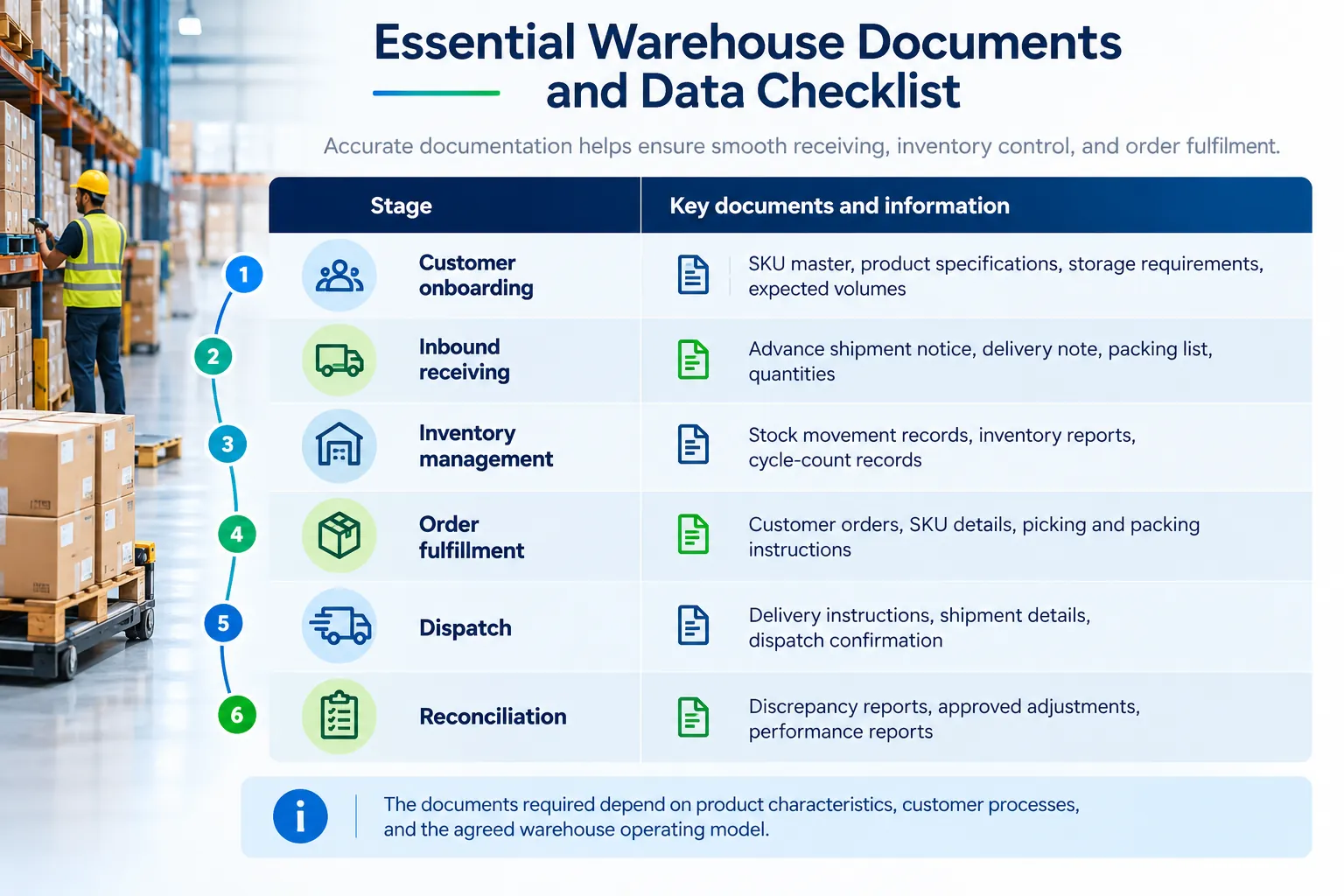
3. Customer Responsibilities in Warehouse Operations
Successful warehouse management depends on accurate information and clear coordination between the customer and warehouse provider.
Customers should provide:
Product and inventory information
- SKU master, product descriptions, dimensions, and weights
- Expected inventory levels and shipment volumes
- Packaging, storage, and special handling requirements
- Batch, serial-number, or expiry-date tracking requirements, where applicable
Order and distribution requirements
- Order formats and authorized contacts
- Expected order volumes and seasonal demand
- Picking, packing, and labelling instructions
- Delivery destinations and dispatch timelines
Operational approvals
- Inventory adjustment and discrepancy approvals
- Reporting and escalation requirements
- Instructions for damaged, restricted, or quarantined stock
Providing complete and accurate information during onboarding helps minimize operational delays and inventory discrepancies.
4. ZenXL's Role in Warehousing and Fulfillment
ZenXL supports businesses by coordinating warehouse activities through defined operational processes and agreed service requirements.
Depending on the contracted scope, our responsibilities may include:
- Warehouse onboarding and process setup
- Inbound receiving and inventory recording
- Storage and stock location management
- Inventory movement tracking and reporting
- Order picking, packing, and dispatch coordination
- Inventory discrepancy management
- Operational reporting and reconciliation support
Our approach focuses on connecting inventory management, warehouse execution, and transportation coordination to support efficient supply chain operations.
Specific service levels, systems, handling arrangements, and responsibilities are established during customer onboarding and contracting.
6. Managing Common Warehouse Challenges
Warehouse operations can encounter exceptions that affect inventory accuracy and order fulfillment.
Receiving discrepancies: Differences between delivered quantities and shipment documents should be recorded, investigated, and communicated.
Damaged goods: Visible damage should be documented, with affected inventory handled according to agreed instructions.
Inventory mismatches: Differences between physical stock and inventory records require reconciliation and authorized adjustments.
Stock shortages: Unavailable inventory may require replenishment, partial fulfillment, or order rescheduling.
Picking and packing errors: Verification procedures help identify incorrect products, quantities, or labels before dispatch.
Delivery delays: Coordinated communication between warehouse teams, transportation providers, and customers helps manage revised delivery expectations.
A well-defined exception management process helps reduce disruption and maintain accountability.
7. Benefits of Professional Warehousing and Fulfillment Services
Outsourcing warehouse operations to an experienced logistics partner can help businesses improve supply chain efficiency.
Key benefits include:
- Improved inventory visibility: Better tracking of stock quantities, locations, and movements.
- Operational efficiency: Structured receiving, storage, and order fulfillment processes.
- Scalability: Warehouse operations planned around changing inventory and order volumes.
- Cost optimisation: More effective use of warehouse space, resources, and logistics processes.
- Better order accuracy: Defined picking, packing, and verification procedures.
- Integrated distribution: Closer coordination between warehousing, transportation, and delivery.
The benefits achieved depend on the warehouse operating model, systems, processes, and agreed service levels.
8. Frequently Asked Questions About Warehousing and Fulfillment
What is the difference between warehousing and fulfillment?
Warehousing focuses on receiving, storing, and managing inventory. Fulfillment involves processing orders, picking and packing products, and preparing shipments for delivery.
What are 3PL warehousing services?
Third-party logistics (3PL) warehousing allows businesses to outsource activities such as inventory storage, stock management, order fulfillment, and dispatch to a logistics service provider.
How is inventory accuracy maintained in a warehouse?
Inventory accuracy is supported through receiving verification, stock movement recording, location tracking, cycle counts, reconciliation, and authorized stock adjustments.
Can ZeNXL manage both warehousing and transportation?
Yes. ZeNXL can coordinate warehousing and transportation services as part of an integrated logistics arrangement, subject to location, operational requirements, and agreed service scope.
Can ZeNXL support batch-level or serial-number inventory tracking?
Batch and serial-number tracking can be supported where the required systems, operating processes, and service arrangements are established.
How long does warehouse onboarding take?
Implementation timelines depend on inventory volume, product requirements, facility availability, system integration, and operational readiness.
What information is required for a warehousing proposal?
Businesses should share product details, expected inventory levels, inbound and outbound volumes, storage requirements, locations, order frequency, and any special handling needs.
9. Why Choose ZeNXL for Warehousing and Fulfillment?
At ZeNXL, we understand that efficient warehousing is not simply about storing products. It is about maintaining inventory accuracy, fulfilling orders, and connecting warehouse operations with wider distribution requirements.
Our approach combines:
- Structured warehouse operations — Defined receiving, storage, and dispatch processes.
- Inventory visibility — Documented stock movements and operational reporting.
- Integrated logistics coordination — Connecting warehousing, fulfillment, and transportation.
- Operational accountability — Clear responsibilities, discrepancy handling, and escalation.
- Flexible service models — Solutions aligned with customer requirements and agreed operating scope.
We help businesses build more organized, responsive, and efficient warehouse operations.
10. Looking for a Warehousing and Fulfillment Partner in India?
Let's Build the Right Warehouse Solution for Your Business.
Whether you need inventory storage, warehouse management, order fulfillment, or integrated warehousing and distribution services, ZeNXL can help you evaluate the right operating model.
Share your product profile, expected inventory volumes, order requirements, and preferred locations with our team.
Optimize Inventory. Streamline Fulfillment. Keep Your Business Moving.